

 UPSC Exams
  UPSC CSE
 UPSC CAPF
 UPSC CDS
 UPSC NDA
 UPSC EPFO
 UPSC CISF LDCE
 State Upper PCS
  UPPSC PCS
 BPSC CCE
 RPSC RAS
 MPPSC (Madhya Pradesh) CCE
 MPSC (Maharasthra) Rajyaseva
 WBPSC WBCS
 GPSC CCE
 KPSC (Karnataka) KAS
 APSC (Assam) CCE
 View More
 Defence
 AFCAT
AFCAT BSF SI
 Indian Army Agniveer
 Banking
  IBPS PO
 SBI PO
 RBI Grade B
 Cental Bank Of India Apprentice
 IDBI Junior Assistant Manager
 SSC
SSC  Police
  Bihar Police SI
 UP Police SI
 Delhi Police Head Constable
 Rajasthan Police SI
 WB Police SI
 Assam Police SI
 Odisha Police SI
 Railway
 Other State Exams
 Insurance
 Regulatory Body
Architecture: Indus Valley
The word ‘architecture’ ‘architecture’ comes from Latin architectura, derived from Greek arkhitekton, combining archi- (chief/master) and tekton (builder or carpenter), When the early man began to build his shelter to live in, the science of architecture started.
1. Difference between Architecture and Articfacts
| Point of Difference | Architecture | Artificat |
|---|---|---|
| Size and Scope | Architecture refers to the design and construction of building. | Artifacts are relatively small 3-dimensional works of art. |
| Material Used | Uses a mixture of various type of materials like stone, wood, glass, metal, sand, etc. | A single piece is usually made of a single type of material. |
| Principle | Involves study of engineering and engineering mathematics. It requires detailed and accurate measurements. | Involves creativity and imagination and may not depend as heavily on accurate measurements. |
| Example | Taj Mahal, Red Fort, etc. | Harappan seals, the “Dancing Girl” sculpture, tools, pottery, beads |
Instead to studing Indian architecture dynasty wise in Art and Culture we are grouping Indian architecture by type (Cave, Hindu Temple, Buddhist , Jain , Islamic, Regional, Modern) as it offers a more thematic and comparative understanding, revealing shared principles and evolutionary patterns across different rulers and eras, instead of strictly by dynasty . Since Architecture of Indus Valley is Unique and Cannot be grouped into any of the above Type we are Studing it as Seperate
2. Indus Valley Architecture
Although art forms like pottery, sculpture etc., had taken shape in prehistoric period, yet architecture in its present forms has its roots in Indus valley civilization in the form of town planning. The Indus Valley Civilisation is also known as the Harappan Civilisation extended from in its mature phaseⓣfrom witnessed the development of some of the earliest big buildings in India.

A flourishing civilisation emerged on the banks of the river Indus in the second half of the third millennium BCE and spread across large parts of North-Western and Western India. There are various important sites of Indus valley civilization each with its unique architectural features along with similarities. These sites possessed a flourishing urban architecture. Harappa and Mohenjo-daro – the two major sites of this civilisation – are among the earliest and finest examples of urban civic planning.
The fact that the Harappan civilization was urban does not mean that all or even most of its settlements had an urban character. A majority were in fact villages. Mainly two types of buildings have been found in the excavation – Dwelling Houses and Public Buildings – Which can be further divided based on their usage for the Populace – Public Gathering Sites – Great Bath or Assembely Hal at Mohenjodaro, Water Management Structures like the Dockyard at Lothal or the Granaries found in Harappa or Mohenjodaro sites.
2.1 Basic City Plan Architecture and Features
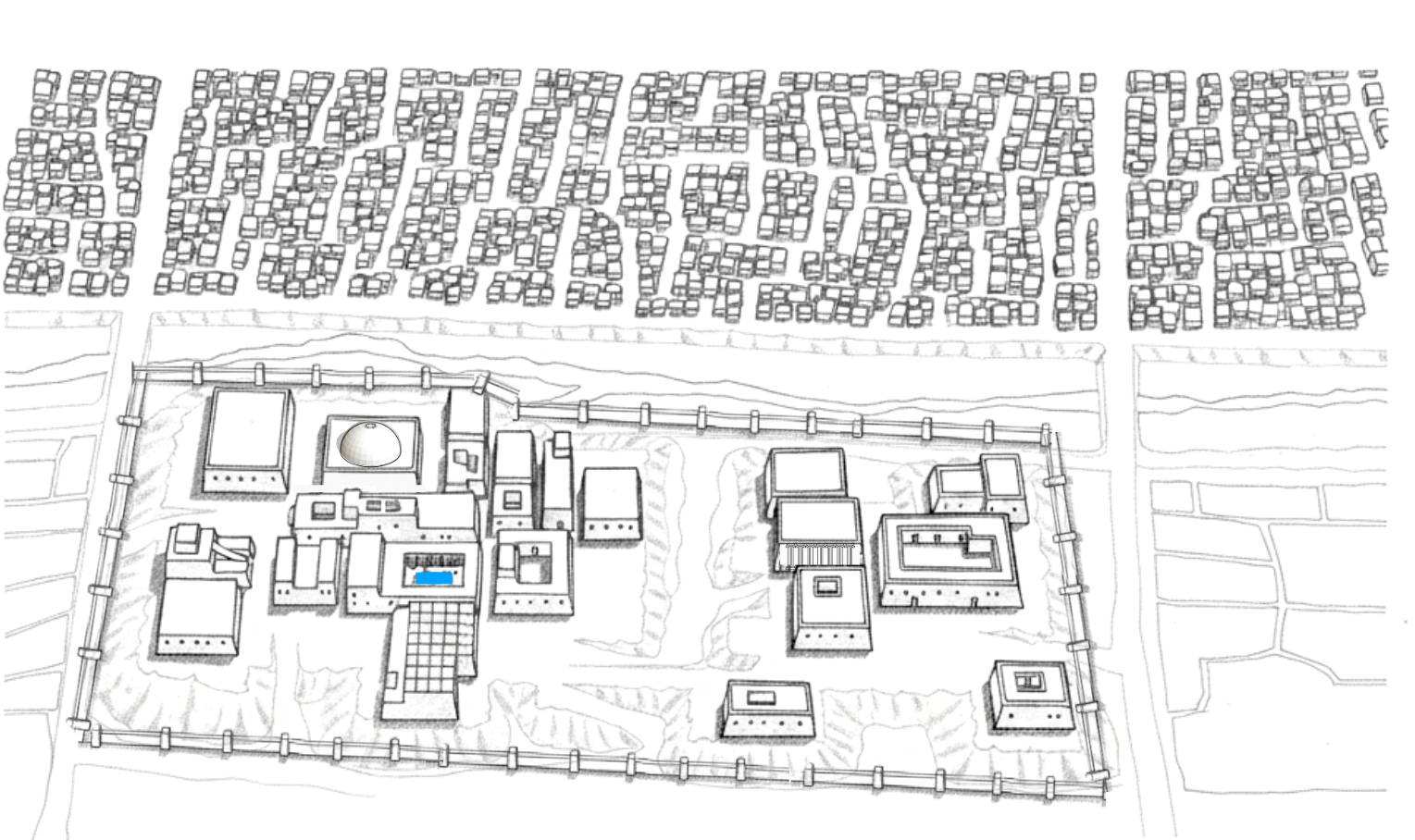
In most sites, cities were divided into 2 parts:
✦ Citadel/ Acropolis : It is smaller and higher (standing some 40 to 50 feet above) than the rest of the area and ⓣsituated on of the town. The citadel area had important residential structures that the public or select residents either used.

All Harappan Cities have a Citadel . However an important manufacturing center is notable for being the only majorⓣsettlement lacking a citadel.

✦ Lower town: It occupies much larger area as compared to citadel but is on a lower plain than citadel. It isⓣsituated on of the town . It is divided into wards like chess board. Lower town had houses of various different sizes which, as some researchers believe that, showed people had different economic status.

Most other major Harappan cities, were typically divided into these only two parts. Theⓣcity of is unique tripartite division with a ⓣadditional part between the Citadel and Lower Town


Fortifications
City in the Indus Valley was surrounded by massive walls and gateways The cities were surrounded by fortified walls made of mud bricks, providing protection against robbers, cattle raiders and floods.
Each part of the city was made up of walled sections. Each section included different buildings such as: Public buildings, houses, markets, craft workshops, etc. Although the citadels were walled, it is far from clear that these structures were defensive. They may have been built to divert flood water. Fortification also varied across Indus Valley Cities Lower and Upper Towns
The Nature of Fortifications also differed across cities like In Mohenjodaro and Harappa only the citadel was surrounded by a brick wall. There are cities where both the citadel and the lower city were individually surrounded by a wall like that of. Similarly in some cities we see a fortified citadel, along with a fortified middle town and lower town like ⓣCity
In some cities we see a unique single defensive wall is seen like the ⓣCity of where the citadel and lower residential areas, was encircled together
In some settlements there was no fortification of the city at all like the ⓣCity
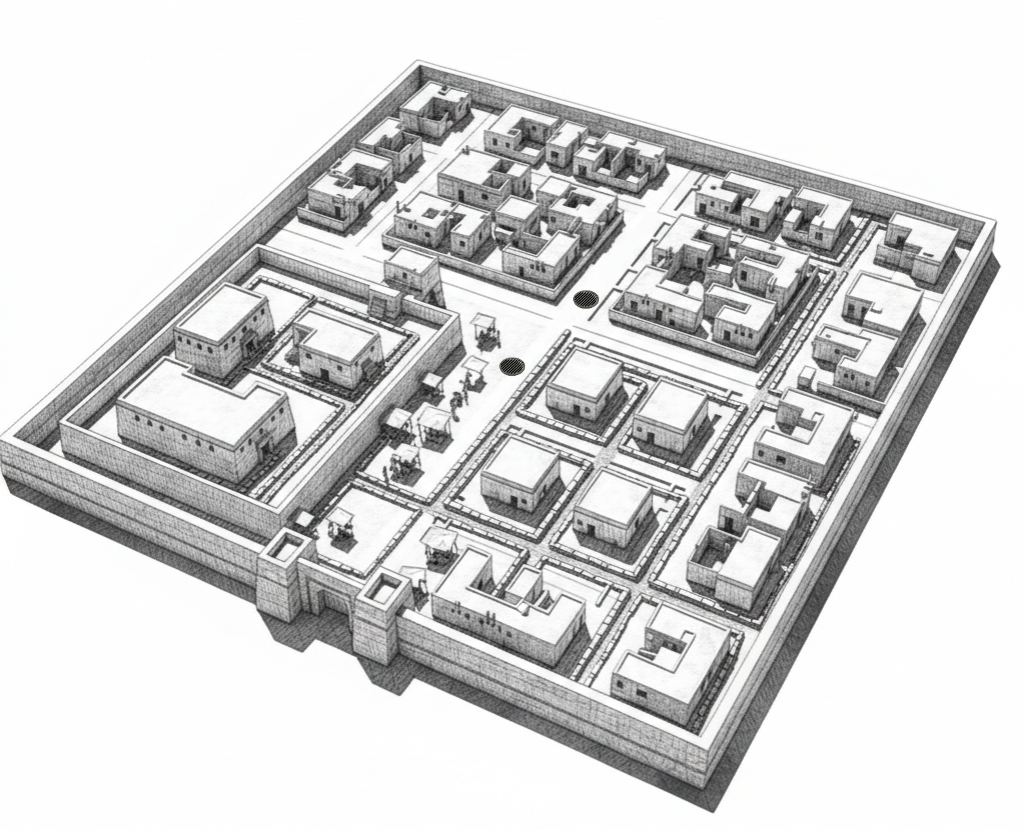
The streets and alleyways of Harappan cities were planned and constructed with precision. They were wide enough to allow the movement of carts and pedestrians, and some streets had covered drains running alongside them.
Note: There is no strict correlation between the level of planning and the size of a settlement. For example, the relatively small site of Lothal shows a much higher level of planning than Kalibangan, which is twice its size.
Themain street was [wp_colorbox_media url=”http://acingacademy.com/wp-content/uploads/2026/01/Screenshot-2026-01-15-094656.png” type=”image” hyperlink=”in Size “] and divided the town into rectangular and square blocks.
Grid System
The streets and houses of Harappan cities were oriented in smaller inner lanes and alleys connected to the main, wider streets, forming a plannedgrid system
Obviously, this kind of alignment of streets and houses represents conscious town planning. However, the resources of the town planners in those days would be very limited. Hence this does not mean every harappan City had a perfect grid system. Roads in the Harappan cities were not always absolutely straight and did not always cross one another at right angles.
Even Mohenjodaro does not show a perfect grid system. This assumption is based on the finds from Mohenjodaro and Kalibangan where the streets stagger from block to block and the alignments of streets and buildings in one part of Mohenjodaro is quite different from the rest of the areas.
Drainage System
Each street had a well organized drain system.There werecovered drains along the road. The main drains were covered by corbelled arches made of brick or stone slabs.
At Harappa and Mohenjodaro, terracotta drain pipes directed waste water into open street drains made of baked bricks. Crucially, the drains were equipped with manholes or inspection holes at regular intervals. These allowed for easy access for regular cleaning and maintenance, preventing blockages and ensuring the system functioned efficiently.
There were rectangular soakpits for collecting solid waste at regular intervals.If the drains were not cleaned, the water ran into the houses and silt built up. Then the Harappans would build another storey on top of it. This raised the level of the city over the years.
The drains for collecting rainwater were separate from the sewage chutes and pipes.Drains and water chutes from the second storey were often built inside the wall, with an exit opening just above the street drain
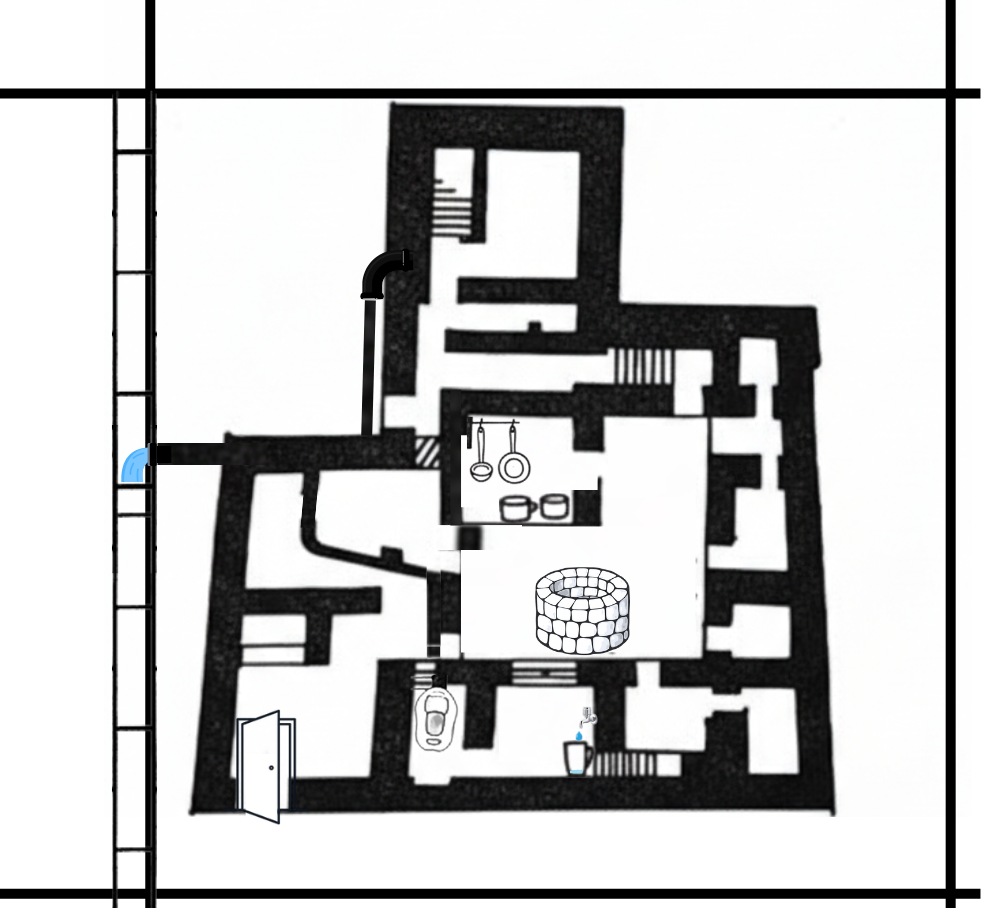
Upper Story
Houses were made of baked bricks, often with multiple stories, indicating a well-developed urban society. The average citizen seems to have lived in the blocks of houses in the lower city.
In the larger houses, passages led into inner rooms. The Various Features of Harappan Housing are Explained as under
Central Courtyard
In the Indus Valley Civilization (IVC), houses were built around a central courtyard, which served as the focal point for living, light, and ventilation, with rooms opening onto it. It Provided light, air, and space for daily activities; sometimes had private wells and bathrooms.
The bigger houses or groups of houses were usually provided with separate so each house could have its own water. Especially in Mohenjo-Daro, which had around 700 wells. Cities like Dholavira also featured sophisticated water harvesting, using stepwells and reservoirs
The view from the lane into the courtyard was blocked off by a wall.
Kitchen
Generally house had both an indoor and outdoorkitchen.
The outdoor kitchen would be used when it was warmer (so that the oven wouldn’t heat up the house), and the indoor kitchen for use when it was colder.
In present day, village houses in this region (e.g. in Kachchh) still have two kitchens.
Stairs
There are remains of staircases that may have led to the roof or a second storey.
The fact that some of the houses at Mohenjodaro were two stories high or more is also suggested by the thickness of their walls.
Doors and Windows
The doors and windows of houses were made of wood and mats. Clay models of houses show that doors were sometimes carved or painted with simple designs. Windows had shutters (perhaps made of wood or reeds and matting), with latticework grills above and below to allow in light and air.
In most Harappan cities like Mohenjo-Daro, house doors faced , not the main streets, a design choice emphasizing privacy, dust control, and a structured urban layout where main roads were for through traffic, not direct house access, though exceptions like Lothal existed – notably possesses houses with doors opening directly onto main streets in its lower town.
Bathrooms and Toilets
Although some people may have used the area outside the city walls to relieve themselves, toilets have been identified at many sites. They ranged from the simple hole in the ground above a cesspit to more elaborate arrangements. Recent excavations at Harappa have uncovered toilets in almost every house.
The commodes were made of big pots sunk into the floor, many of them associated with a small lota-type jar, no doubt for washing up. Most of the pots had a small hole in the base, through which water could seep into the ground.
The waste from the toilets was in some cases discharged through cutting through the house wall, and went out into the street, connecting ultimately with a larger sewage drain.
Bathing platforms with drains were often located in rooms next to a well.
The floor of the bathing area was usually made of tightly fitted bricks, frequently set on edge, to make a carefully sloped watertight surface.
Multi Stories
Houses often had one or two stories, with stairs leading to the upper level. The fact that some of the houses at Mohenjodaro were two stories high or more is also suggested by the thickness of their walls. This was also must be a Class Distinction suggesting social hierarchy.
Even the Upper Floors had efficent Waste Disposal solutions as the chutes from upper floors were connecting to covered street drains
A major difference between the buildings in large cities and those in smaller towns and villages was in the type and combination of raw materials used. In villages, houses were made mostly of mud-brick, with the additional use of mud and reeds; stone was occasionally used for foundations or drains.
Buildings in towns and cities were made of sun-dried and burnt bricks. In Harappa and Mohenjodaro baked bricks were used for buildings. In the [wp_colorbox_media url=”http://acingacademy.com/wp-content/uploads/2026/01/Screenshot-2026-01-14-202923.png” type=”image” hyperlink=” city of “] mud bricks were used. In the rocky areas of Kutch and Saurashtra, however, there was extensive [wp_colorbox_media url=”http://acingacademy.com/wp-content/uploads/2026/01/Screenshot-2026-01-14-203022.png” type=”image” hyperlink=” use of “]
The massive fortification walls with a veneer of dressed stone at Dholavira and the remains of stone pillars in the citadel are very distinctive and are not found at any other Harappan site. The fact that some house walls at Mohenjodaro survive upto a height of 5 m is a tribute to the strength of the bricks and the brick-laying skill of the Harappans.
There were various styles of laying bricks, including what is known as the ▷English Bond Style .This gave the wall maximum load-bearing strength.
A striking feature of Harappan structures is the uniformity in the average size of the bricks — 7 × 14 × 28 cm for houses and for city walls size [wp_colorbox_media url=”http://acingacademy.com/wp-content/uploads/2026/01/Screenshot-2026-01-14-203129.png” type=”image” hyperlink=” used was “] used was . Both these brick sizes have an identical ratio of thickness, width, and length . See the Original Image of the [wp_colorbox_media url=”http://acingacademy.com/wp-content/uploads/2026/01/Screenshot-2026-01-14-201908.png” type=”image” hyperlink=” Harappan Brick “] maintaining the [wp_colorbox_media url=”http://acingacademy.com/wp-content/uploads/2026/01/Screenshot-2026-01-14-203041.png” type=”image” hyperlink=” ratio”]
This ratio first makes its appearance at a few sites in the early Harappan phase, but in the mature Harappan phase, it is found in all the settlements. Bricks of standard size shows that it was not the individual house owners who made their own bricks, but that brick making was organised on a large scale.
2.2 Important Public Buildings and their Location
Indus Valley Public buildings can be classified into four specific types (public gathering, granaries, water management, and factories)
The primary public gathering structures identified in the Indus Valley Civilization are the Great Bath and the Pillared Assembly Halls
Great Bath
The Great Bath, is an example of Harappan engineering skill It must have served as a ritual bathing site rather than daily, mundane bathing and Reflects the sophisticated town planning and high priority on hygiene in the Indus Valley Civilization.
It was constructed using baked bricks, gypsum mortar, A thick layer of bitumen was laid along the sides of the tank and below the floor, making this one of the earliest examples of waterproofing in the world. Check the Various Visual Features of the⛞Great Bath
Pillared Hall
The ⛶pillared hall was The hall was a large, square, pillared structure measuring roughly

It contained 20 square brick pillars arranged in four rows of five pillars each.Constructed primarily with sturdy kiln-baked bricks.Flooring: The floor consisted of paved, raised strips that sloped slightly, with rows of bricks set on edge along both sides.. Believed to be a public or assembly hall for likely used for civic, administrative dealings for rulers and Officials or religious assemblies for general populace.
Stadium
The ⛶stadium of Dholavira, is a large, terraced open area with tiered stands, unique for an IVC site, believed to be used for public gatherings, ceremonies, or sports, highlighting advanced urban planning.
Indus Valley Civilization granaries were large, sophisticated structures , built on raised platforms with ventilation systems to store surplus grains (wheat, barley) and protect them from floods and pests, crucial for food security and trade
Great Granary
The Great Granary of Mohenjodaro is a massive, large brick structure identified by early archaeologists like Sir Mortimer Wheeler as a grain storage facility, built on a raised platform with ventilation, though some modern scholars suggest it might have been a large public hall due to limited grain evidence. It measures roughly 45.7 meters (150 ft) long by 15.2 meters (50 ft) wide
Its is the largest building discovered at this Indus Valley Civilization site, a massive brick structure built on a raised platform with ventilation channels, likely used for storing grain, though some scholars suggest it could have been a public hall. Check the Various Visual Features of the⛞Great Granary
Granary on Mound F
The “granary” (or great hall) on Mound F at Harappa is a massive Bronze Age structure. It was initially considered a, granary for storing food surpluses, though some archaeologists now describe it as a “great hall” because no significant amounts of grain or storage containers were found inside.. Check the Various Visual Features of the⛞Granary on Mound F
Indus Valley Civilization granaries were large, sophisticated structures , built on raised platforms with ventilation systems to store surplus grains (wheat, barley) and protect them from floods and pests, crucial for food security and trade
Dockyard
The Lothal dockyard, is considered the world’s earliest known artificial dock, showcasing advanced Harappan maritime engineering.
This brick structure was linked to an ancient channel of the Sabarmati River, facilitating, trading, and shipbuilding. was a primary center for extensive maritime trade, trading with distant lands like Sumer (Iraq) and Bahrain. It Demonstrated sophisticated understanding of tides, hydraulics, and construction. Check the Various Visual Features of the⛞Dockyard
Gaint Water Reservoir
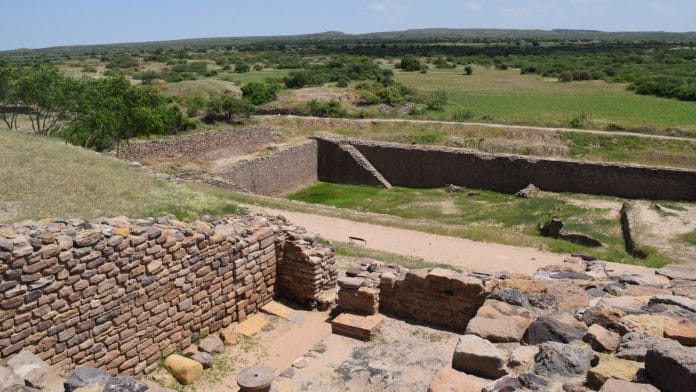
At least 16 large, stone-built ⛶reservoirs, some extremely large (e.g., one nine times an Olympic pool size) have been discovered. This Represents one of the world’s earliest and most advanced water management systems. Provided a reliable water supply in an arid zone by capturing seasonal rainwater.
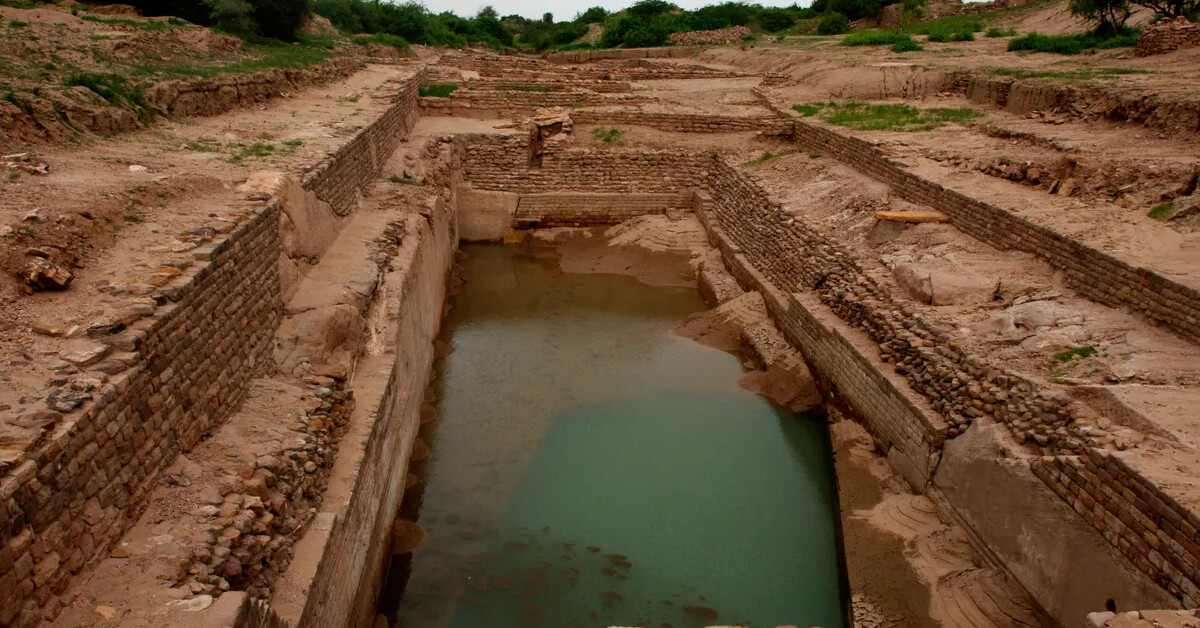
Built partly by scooping out rock and reinforced with stone masonry. A network of directed water from storm drains into the reservoirs. It also had leading into reservoirs suggest methods for drawing water, possibly for industrial or domestic use.