

 UPSC Exams
  UPSC CSE
 UPSC CAPF
 UPSC CDS
 UPSC NDA
 UPSC EPFO
 UPSC CISF LDCE
 State Upper PCS
  UPPSC PCS
 BPSC CCE
 RPSC RAS
 MPPSC (Madhya Pradesh) CCE
 MPSC (Maharasthra) Rajyaseva
 WBPSC WBCS
 GPSC CCE
 KPSC (Karnataka) KAS
 APSC (Assam) CCE
 View More
 Defence
 AFCAT
AFCAT BSF SI
 Indian Army Agniveer
 Banking
  IBPS PO
 SBI PO
 RBI Grade B
 Cental Bank Of India Apprentice
 IDBI Junior Assistant Manager
 SSC
SSC  Police
  Bihar Police SI
 UP Police SI
 Delhi Police Head Constable
 Rajasthan Police SI
 WB Police SI
 Assam Police SI
 Odisha Police SI
 Railway
 Other State Exams
 Insurance
 Regulatory Body
Architecture : Temple Architecture
The temple architecture in India has evolved over the ages as the style changed along with the changing dynasties and regions. It was in the 600–750 A.D. period that temple architecture crystallised into the Nagara style in the north and the Dravida style in the south. A fusion between the Nagara and Dravida styles, which emerged in the Deccan, eventually matured into the Vesara style in the post-750 A.D. period. While the architecture of Hindu temples varies from region to region, the major components of a temple remain constant. These components are garbhagriha or the sanctum, mandapa, shikhara, and vaahan.
1.The Basic Form of Temple Architecture in India
Based on geographical location and architectural style, Hindu temples can be characterised mainly under two types —Nagara in the north and Dravida in the south..The distinction can be made by comparing the elevation of the temple, the forms of the spire, and the plan of the temple. At times, the Vesar style of temples as an independent style created through the selective mixing of the Nagara and Dravida orders is mentioned by some scholars.
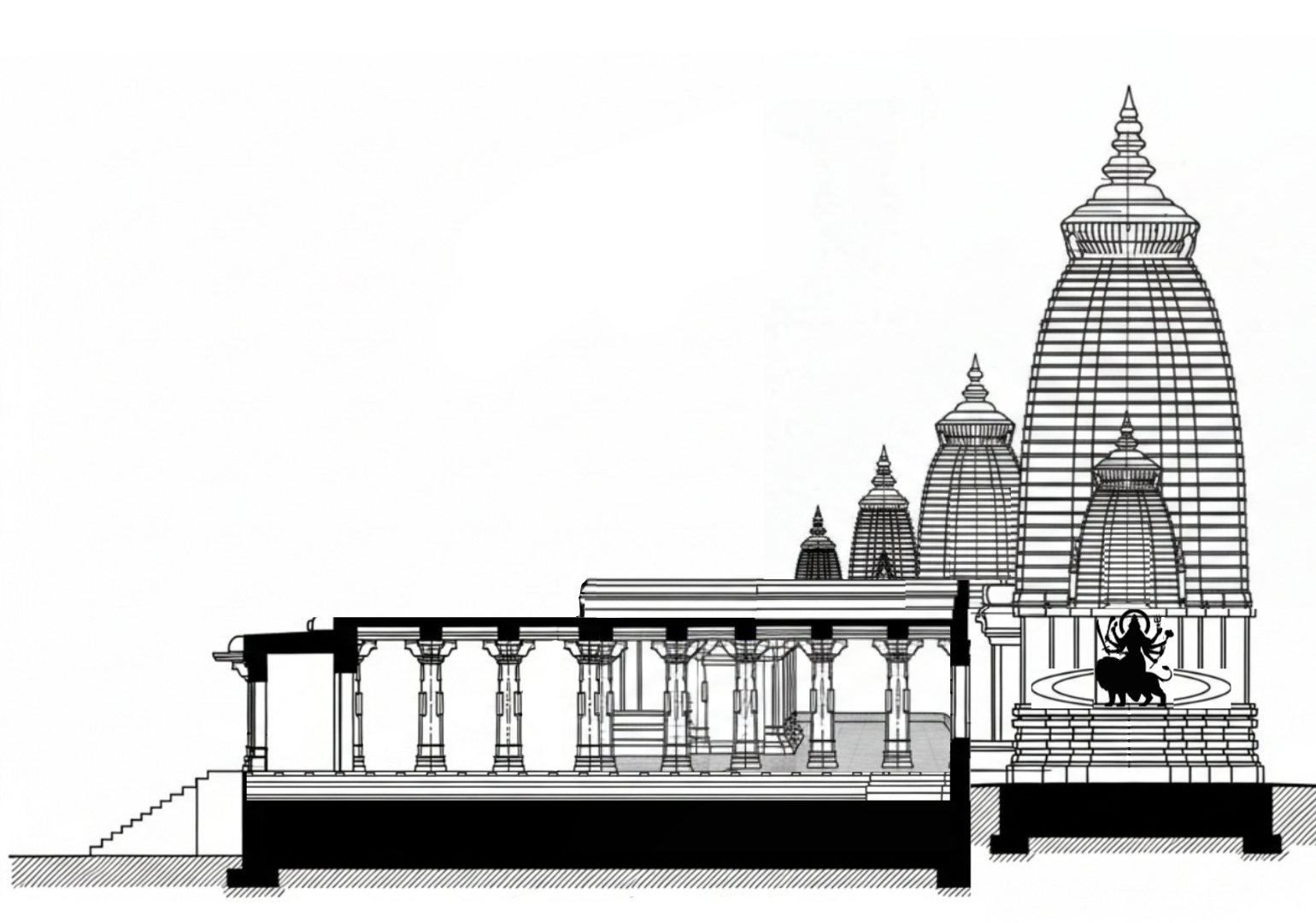
Nagara Style: The style of temple architecture that became popular in northern India is known as nagara. The Nagara style is not limited to a single time; it blossomed during the Gupta dynastyand continued to evolve throughout different regional kingdoms and empires that controlled northern India. Let us know about Nagara Style First
Basic Elements of a Nagara Temple Architecture
1) Jagati: It is a raised platform for sitting and praying and is Exclusive in North Indian temples
2) Mandapa It is the entrance to the temple. It is a large hall that incorporates space for a large number of worshippers. Dances and such other entertainments are practiced here. Some temples have multiple mandapas in different sizes named as Ardhamandapa, Mandapa, and Mahamandapa.
3) Antarala is the (vestibule) is a transition area between the Garbhagriha and the temple’s main hall (mandapa).
4) Garbhagriha : It is a small cubical structure with a single entrance. is made to house the main icon (main deity) which is itself the focus of much ritual attention. Ganga and Yamuna rivers are depicted in personified form at the entrance of Garbhagriha while in south Sculptures of fierce dvarapalas or door keepers guarding the temple.
5) Vahana: It is the mount or vehicle of the temple’s main deity along with a standard pillar
6) Shikhara or Vimana : It is Mountain like spire of a free-standing temple. Shikhara is found in North Indian temples and Vimana is found in South Indian temples. A point to note here is in North, While the earliest temples had just one tower or shikhara, later temples had multiple Shikharas. Moreover, different types of shikara in North styles like
Rekha prasad / Latina is the Simplest Shikara with Square base, and the walls curve or slopes inwards to a point on top. Latina types are mainly used for housing the garbhagriha.
Phamsana is Similar in square base but broader and shorter than Latina type. Their roof is composed of several slabs that gently rise to a single point over the centre of the building unlike the Latina ones which look like sharply rising towers. In many north Indian temples, the phamsana type is used for mandapas
While Valabhi has rectangular base and roof like a Chamber. The edge of the vaulted chamber is round, like the bamboo or wooden wagons that would have been drawn by bullocks in ancient times.
7) Pradakshina Path : faithful arc to circumambulate in a clockwise direction.
8) Amalaka : It is a stone disc like structure which is the base of the top Crown element Kalash and they are Exclusive in North Indian temples.
Sub Typs of Nagara Style Based on type of Elements
Each street had a well organized drain system.There were covered drains along the road. The main drains were covered by corbelled arches made of brick or stone slabs.
At Harappa and Mohenjodaro, terracotta drain pipes directed waste water into open street drains made of baked bricks. Crucially, the drains were equipped with manholes or inspection holes at regular intervals. These allowed for easy access for regular cleaning and maintenance, preventing blockages and ensuring the system functioned efficiently.
The drains for collecting rainwater were separate from the sewage chutes and pipes.Drains and water chutes from the second storey were often built inside the wall, with an exit opening just above the street drain.
There were rectangular soakpits for collecting solid waste at regular intervals.If the drains were not cleaned, the water ran into the houses and silt built up. Then the Harappans would build another storey on top of it. This raised the level of the city over the years.
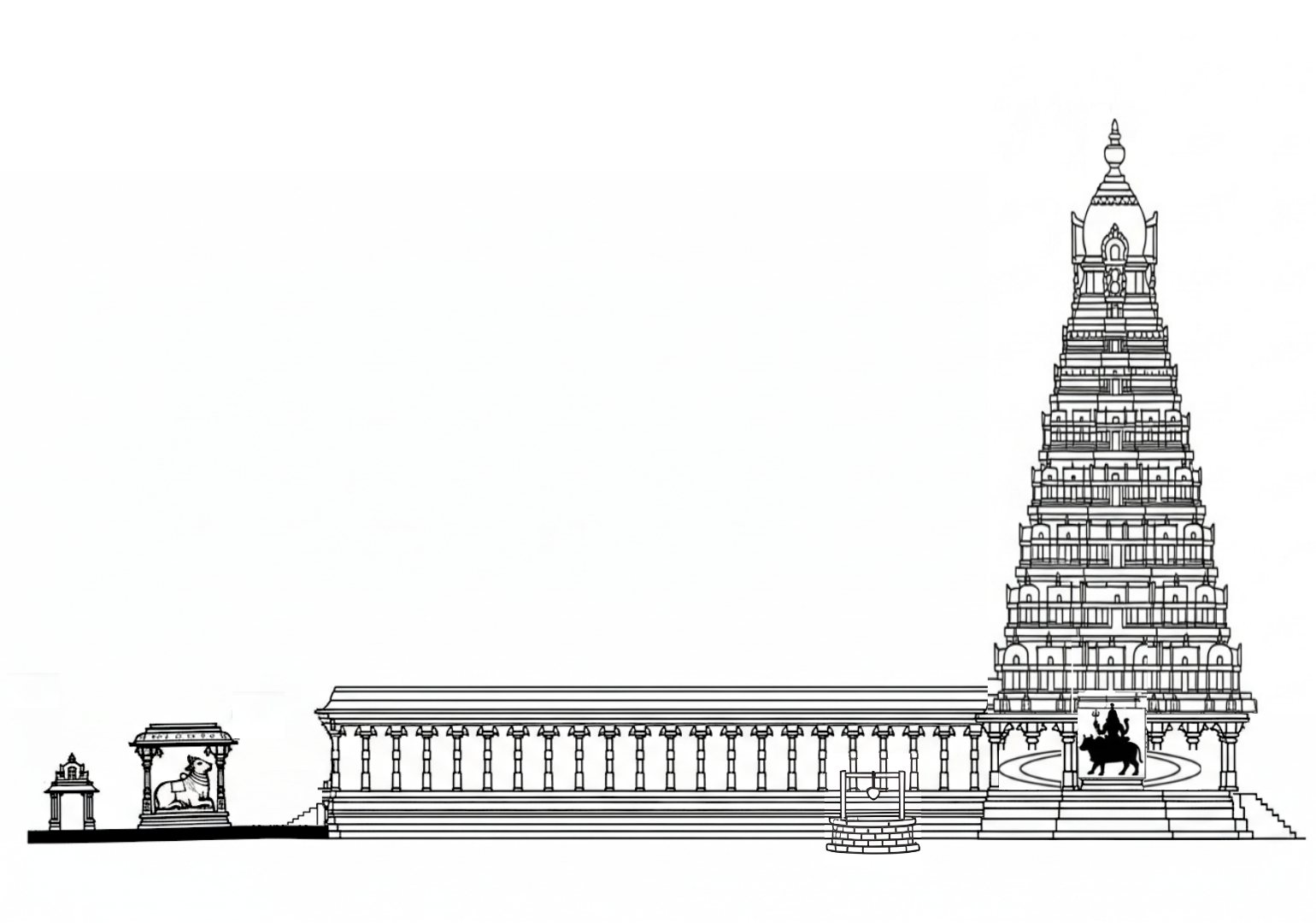
Mandap
Shikara
Nandi Mandap
Water Tank
Vimana
Stuti
The streets and alleyways of Harappan cities were planned and constructed with precision. They were wide enough to allow the movement of carts and pedestrians, and some streets had covered drains running alongside them.
Note: There is no strict correlation between the level of planning and the size of a settlement. For example, the relatively small site of Lothal shows a much higher level of planning than Kalibangan, which is twice its size.
The main street was ten meters wide and divided the town into rectangular and square blocks.
Grid System
The streets and houses of Harappan cities were oriented north–south and east–west. smaller inner lanes and alleys connected to the main, wider streets, forming a planned grid system
But even Mohenjodaro does not show a perfect grid system.
Roads in the Harappan cities were not always absolutely straight and did not always cross one another at right angles.
Obviously, this kind of alignment of streets and houses represents conscious town planning. However, the resources of the town planners in those days would be very limited.
This assumption is based on the finds from Mohenjodaro and Kalibangan where the streets stagger from block to block and the alignments of streets and buildings in one part of Mohenjodaro is quite different from the rest of the areas.
Drainage System
Each street had a well organized drain system.There were covered drains along the road. The main drains were covered by corbelled arches made of brick or stone slabs.
At Harappa and Mohenjodaro, terracotta drain pipes directed waste water into open street drains made of baked bricks. Crucially, the drains were equipped with manholes or inspection holes at regular intervals. These allowed for easy access for regular cleaning and maintenance, preventing blockages and ensuring the system functioned efficiently.
The drains for collecting rainwater were separate from the sewage chutes and pipes.Drains and water chutes from the second storey were often built inside the wall, with an exit opening just above the street drain.
There were rectangular soakpits for collecting solid waste at regular intervals.If the drains were not cleaned, the water ran into the houses and silt built up. Then the Harappans would build another storey on top of it. This raised the level of the city over the years.
2. Various Temples of India (Dynasty Wise) and Mapping them
Note : There are no remains of free-standing Hindu temples erected before the Gupta period. Evidences of temple building did exist but these are mainly literary evidence. Gupta Age, being an age of intense religion interests, saw the construction of many temples and religious architectures. Its often called “The Golden Age of Art and Architecture in India”.
Foundation of structural temple of Nagara architecture was Laid by Guptas. The basic elements of the Indian temple were laid during this time .They were devoid of any Carvings or Sculptures. There structural temples are located at :
Tigawa Temples and Temples of Sanchi
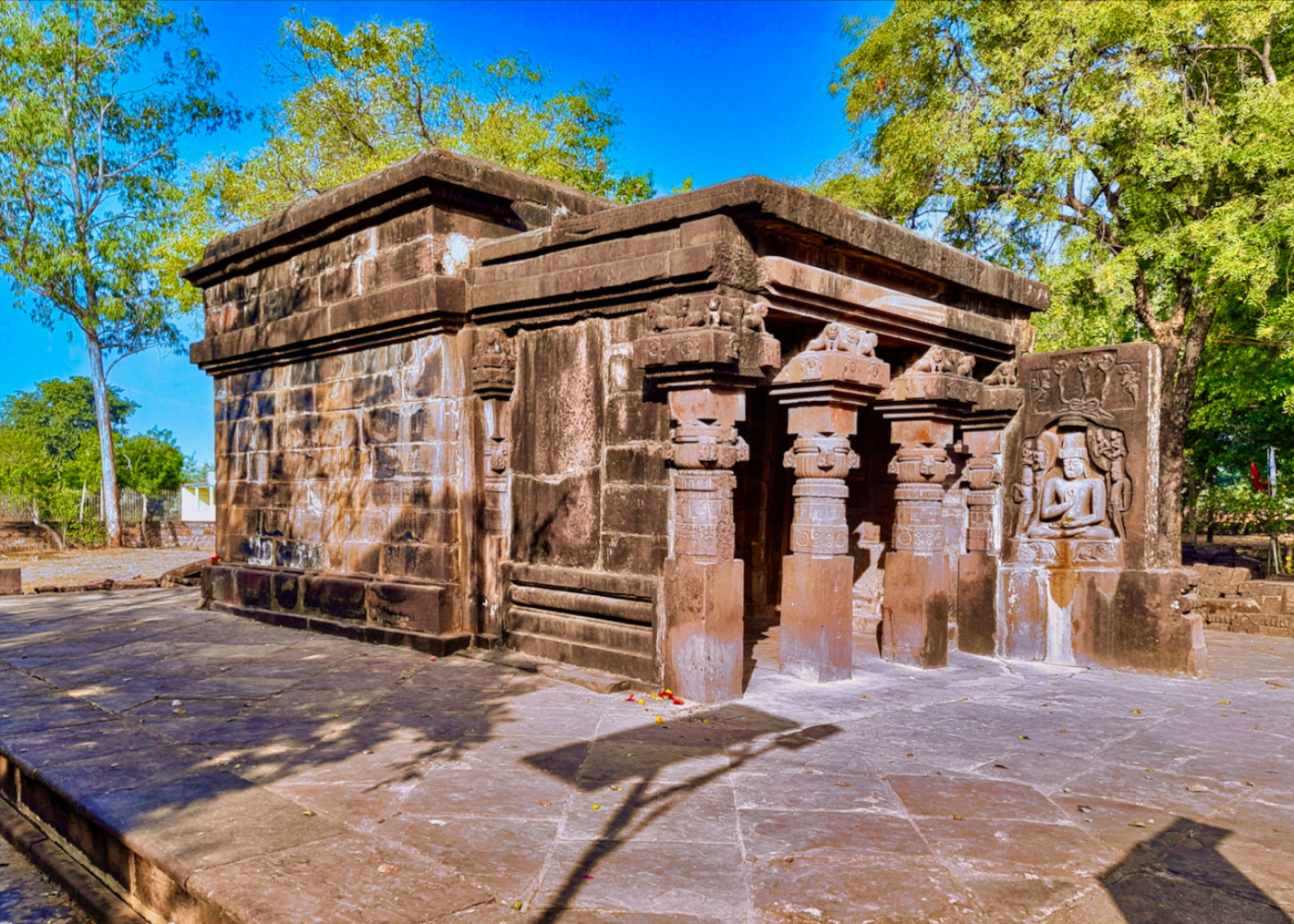
Temple at Tigawa
It has ruins of many Hindu Tmeples of the Gupta Era Of these, the small but important and ancient Kankali Devi Temple is in good condition It is one of the oldest surviving Hindu temples. illustrating the formative stages of Hindu temple architecture. It has a sanctum and an open portico (Mandap) supported on four pillars and the entire structure is developed on low platforms . Similar to this is this Temple no 17 at Sanchi
Nachna Temples and Bhumara Temples
These temples represented the 2nd formative stage with upraised Platforms , ambulatory passageway around the garabgriha .This path was employed as a pradakshina route.
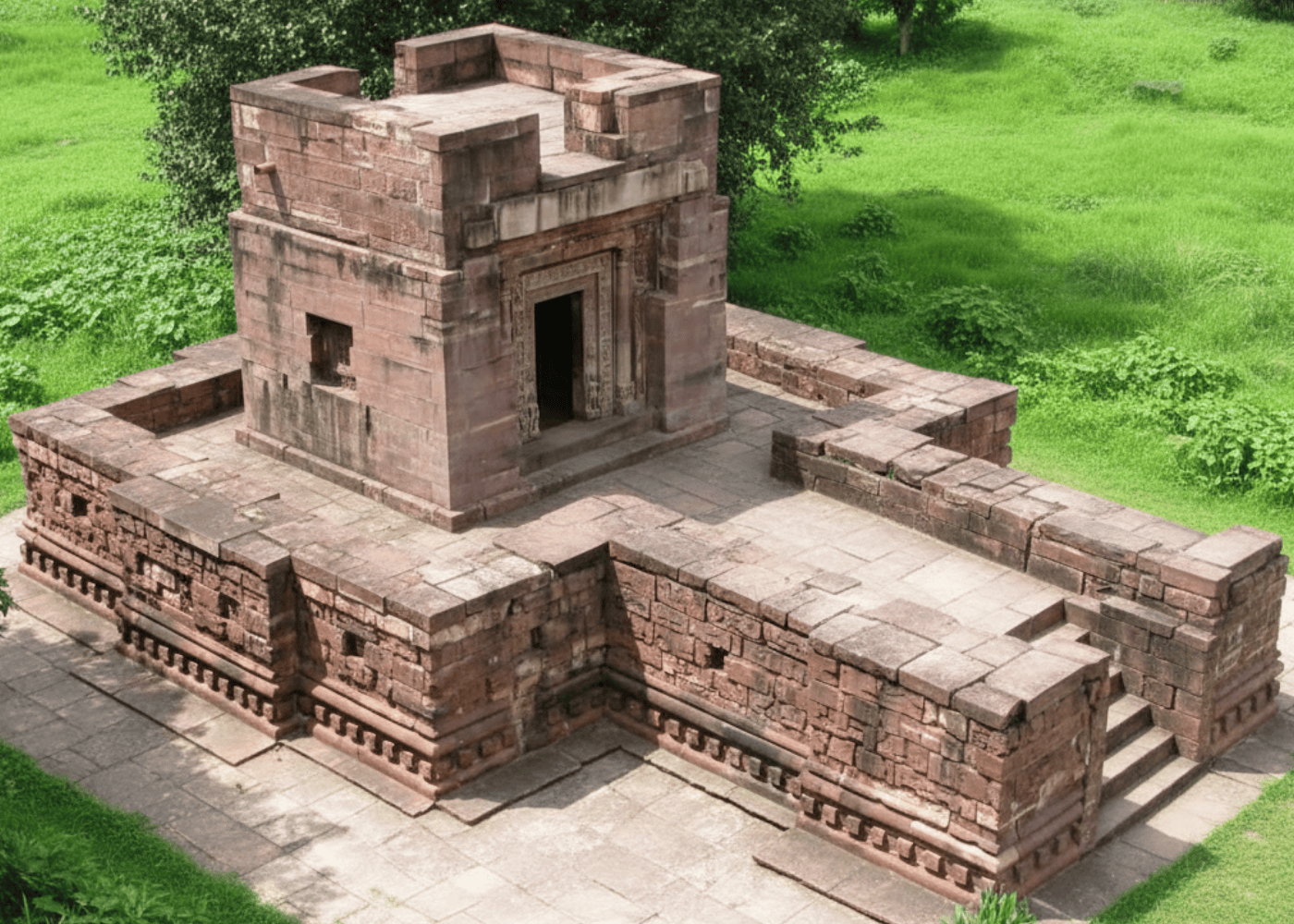
Parvati temple in Nachna Kuthara
Nachna temples are variously dated to the 5th- or 6th-century Gupta Empire era. Most of the temples in the area are in ruins. The best preserved and most studied monument is the Parvati temple at Nachna.There have also been several two-story temples discovered.
Bhumara temple introduced 2 smaller shrines at the flanks of entrance steps.
Temples at Deogarh and Kanpur
Represents the 3rd Formative stage with most of the features of Nagara like emepergence of shikara in place of flat roof , panchyatan Style as the Concept of subsidiary shrines developed
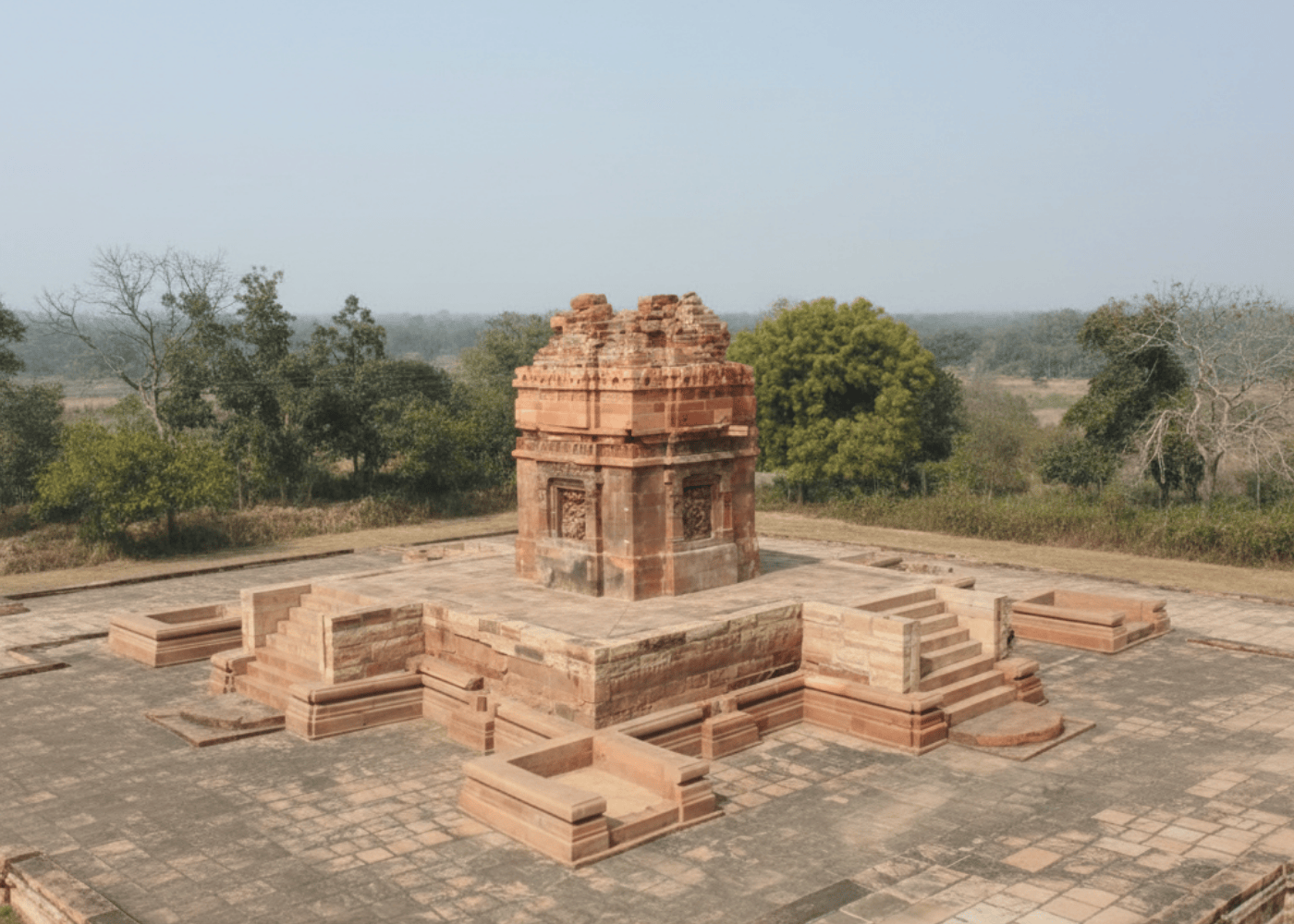
Dashavatar temple in Deogarh, Uttar Pradesh
Eg Dashavatara temple (Deogarh).. The temple has all the elements Consisting of a raised platform, Garbhagriha housing diety on vahana the mandap (Varanda) Shikhara or spire, and Panchyatan style with 4 subsidiary shrines around main temple depicts Vishnu in various forms as well as other gods and goddesses such as Shiva, Parvati, Kartikeya, River goddesses Ganga and Yamuna, as well as a panel showing the five Pandavas of Mahabharata,
Deogarh temple stands on a platform, approached by flights of steps on the 4 sides and is of the Panchyatan type having subsidiary shrines in each corner. It is one of the earliest temple to draw on the stories of Rama and Krishna.
Temple at Sholapur Maharasthra
This stage’s temples were nearly the same, with the exception that the main shrine became more rectangular.
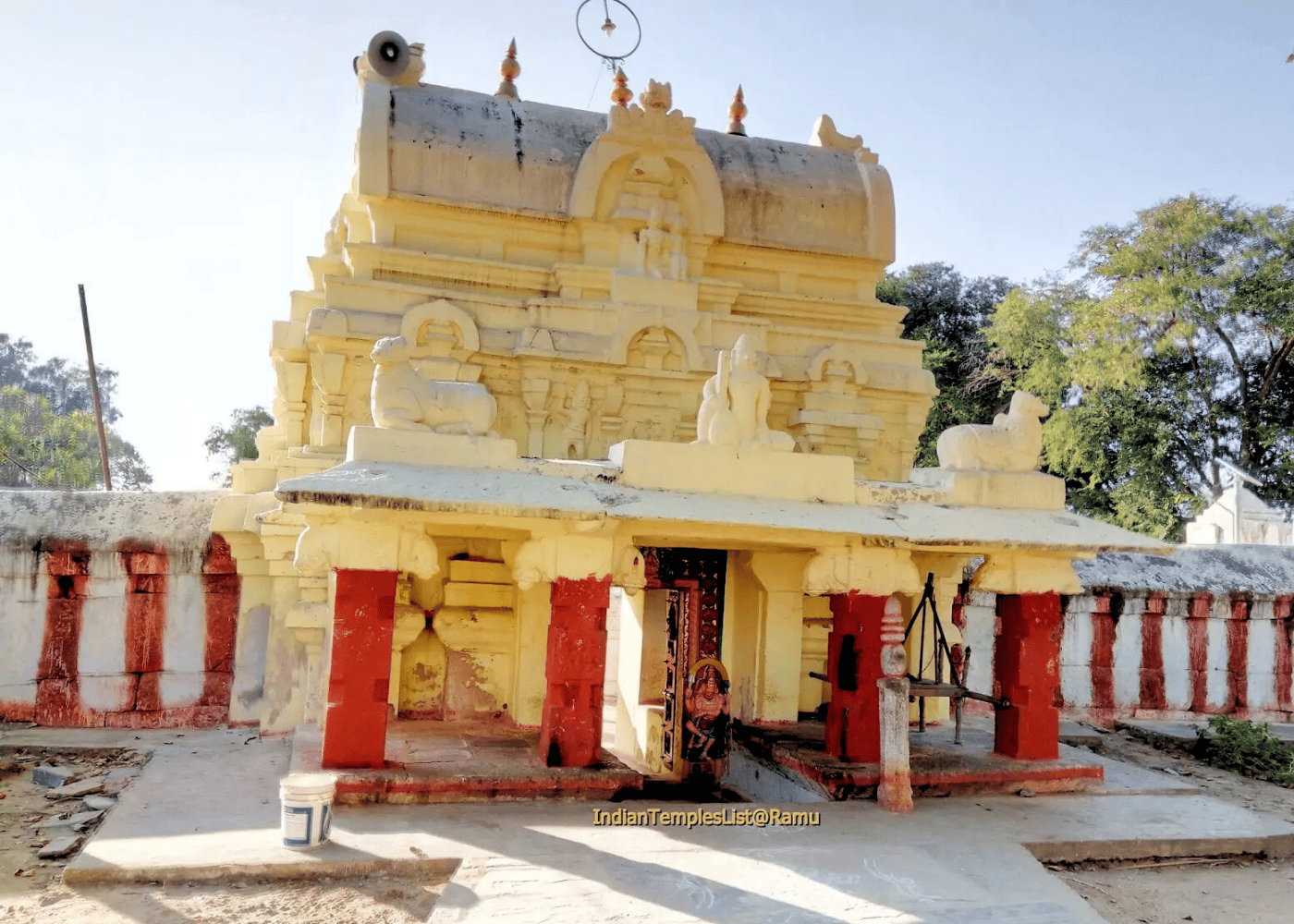
Ter temple at Sholapur (Maharashtra)
Rectangular temple with an apsidal back and barrel-vaulted roof above such as the Kapoteswara temple at Chejarla.
Ter temple at Sholapur (Maharashtra) is an example.
Maniyar Math Temple at Rajgir
This represents the Epitome of Gupta Architecture
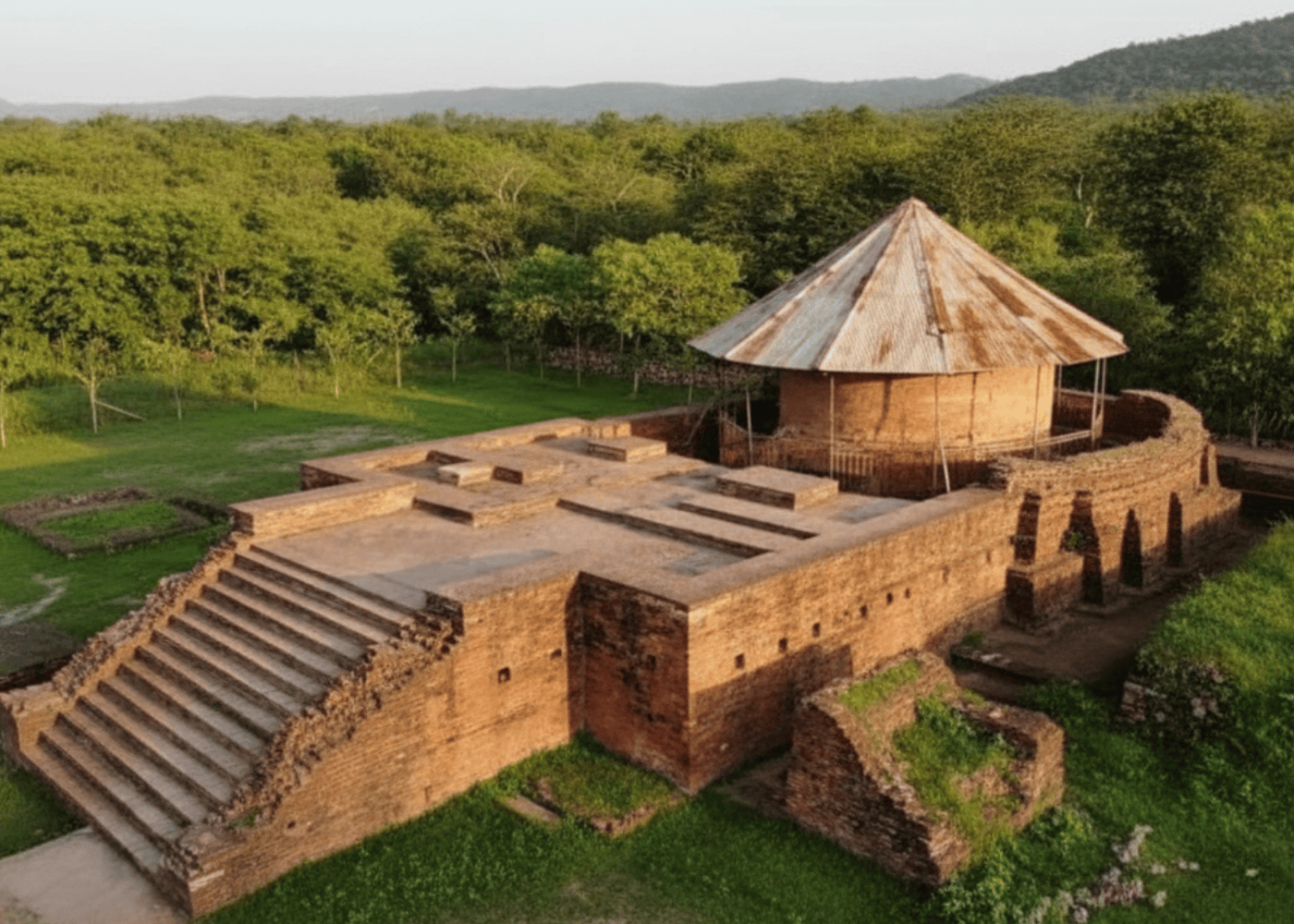
Maniyar Math in Rajgir
Circular temples with shallow rectangular projections were established at this time. The rest of the preceding phase’s characteristics were maintained.
Gurjar Pratiharas Temples
A distinct style within the nagara style Māru-Gurjara architecture was developed during Gurjara Pratihara Empire. Rajasthani architecture) originated in the sixth century in and around areas of the state of Rajasthan in India during Gurjara Pratihara Empire
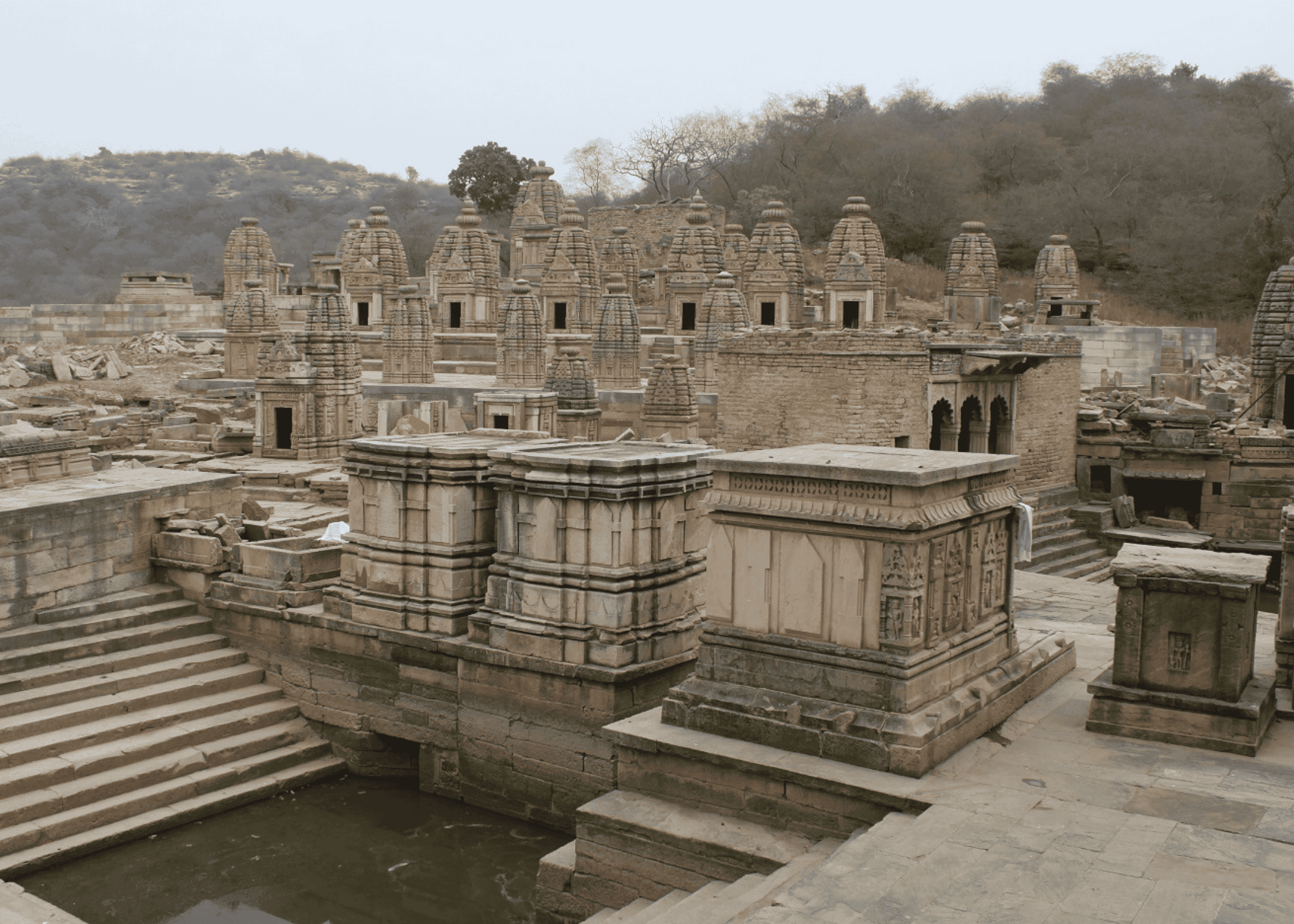
Temple at Bateshwar
Bateshwar and Nareshwar Morena , Hindu temples are a group of nearly 200 sandstone Hindu temples and their ruins in north Madhya Pradesh in post-Gupta, early Gurjara-Pratihara style of North Indian temple architectureThey are dedicated to Shiva, Vishnu and Shakti – representing the three major traditions within Hinduism.
Prabhas Patan : Somnath Temple : Gurjara-Pratihara king Nagabhata II is said to have constructed the temple in 815 CE, a large structure of red sandstone.
Odisha School of Temples
These temples represented the 2nd formative stage with upraised Platforms , ambulatory passageway around the garabgriha .This path was employed as a pradakshina route.
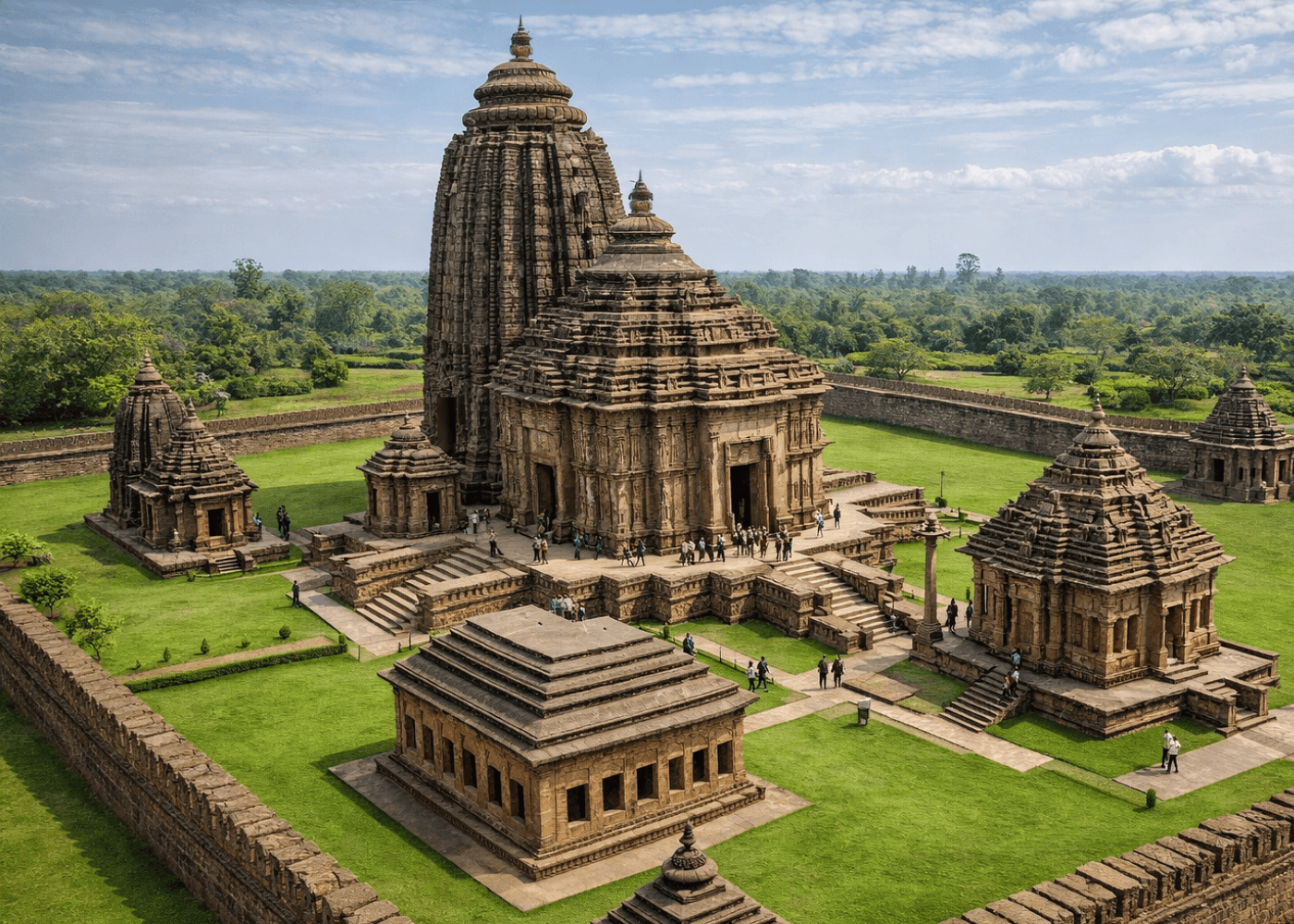
Parvati temple in Nachna Kuthara
Nachna temples are variously dated to the 5th- or 6th-century Gupta Empire era. Most of the temples in the area are in ruins. The best preserved and most studied monument is the Parvati temple at Nachna.There have also been several two-story temples discovered.
Bhumara temple introduced 2 smaller shrines at the flanks of entrance steps.
Khajuraho School of Temples
Represents the 3rd Formative stage with most of the features of Nagara like emepergence of shikara in place of flat roof , panchyatan Style as the Concept of subsidiary shrines developed
Dashavatar temple in Deogarh, Uttar Pradesh
Eg Dashavatara temple (Deogarh).. The temple has all the elements Consisting of a raised platform, Garbhagriha housing diety on vahana the mandap (Varanda) Shikhara or spire, and Panchyatan style with 4 subsidiary shrines around main temple depicts Vishnu in various forms as well as other gods and goddesses such as Shiva, Parvati, Kartikeya, River goddesses Ganga and Yamuna, as well as a panel showing the five Pandavas of Mahabharata,
Deogarh temple stands on a platform, approached by flights of steps on the 4 sides and is of the Panchyatan type having subsidiary shrines in each corner. It is one of the earliest temple to draw on the stories of Rama and Krishna.
Solanki School of Temples
This stage’s temples were nearly the same, with the exception that the main shrine became more rectangular.
Ter temple at Sholapur (Maharashtra)
Rectangular temple with an apsidal back and barrel-vaulted roof above such as the Kapoteswara temple at Chejarla.
Ter temple at Sholapur (Maharashtra) is an example.
Pala School of Temples
This represents the Epitome of Gupta Architecture
Maniyar Math in Rajgir
Circular temples with shallow rectangular projections were established at this time. The rest of the preceding phase’s characteristics were maintained.
Pagoda Style Temple Architecture
This represents the Epitome of Gupta Architecture
Maniyar Math in Rajgir
Circular temples with shallow rectangular projections were established at this time. The rest of the preceding phase’s characteristics were maintained.