
 UPSC Exams
  UPSC CSE
 UPSC CAPF
 UPSC CDS
 UPSC NDA
 UPSC EPFO
 UPSC CISF LDCE
 State Upper PCS
  UPPSC PCS
 BPSC CCE
 RPSC RAS
 MPPSC (Madhya Pradesh) CCE
 MPSC (Maharasthra) Rajyaseva
 WBPSC WBCS
 GPSC CCE
 KPSC (Karnataka) KAS
 APSC (Assam) CCE
 View More
 Defence
 AFCAT
AFCAT BSF SI
 Indian Army Agniveer
 Banking
  IBPS PO
 SBI PO
 RBI Grade B
 Cental Bank Of India Apprentice
 IDBI Junior Assistant Manager
 SSC
SSC  Police
  Bihar Police SI
 UP Police SI
 Delhi Police Head Constable
 Rajasthan Police SI
 WB Police SI
 Assam Police SI
 Odisha Police SI
 Railway
 Other State Exams
 Insurance
 Regulatory Body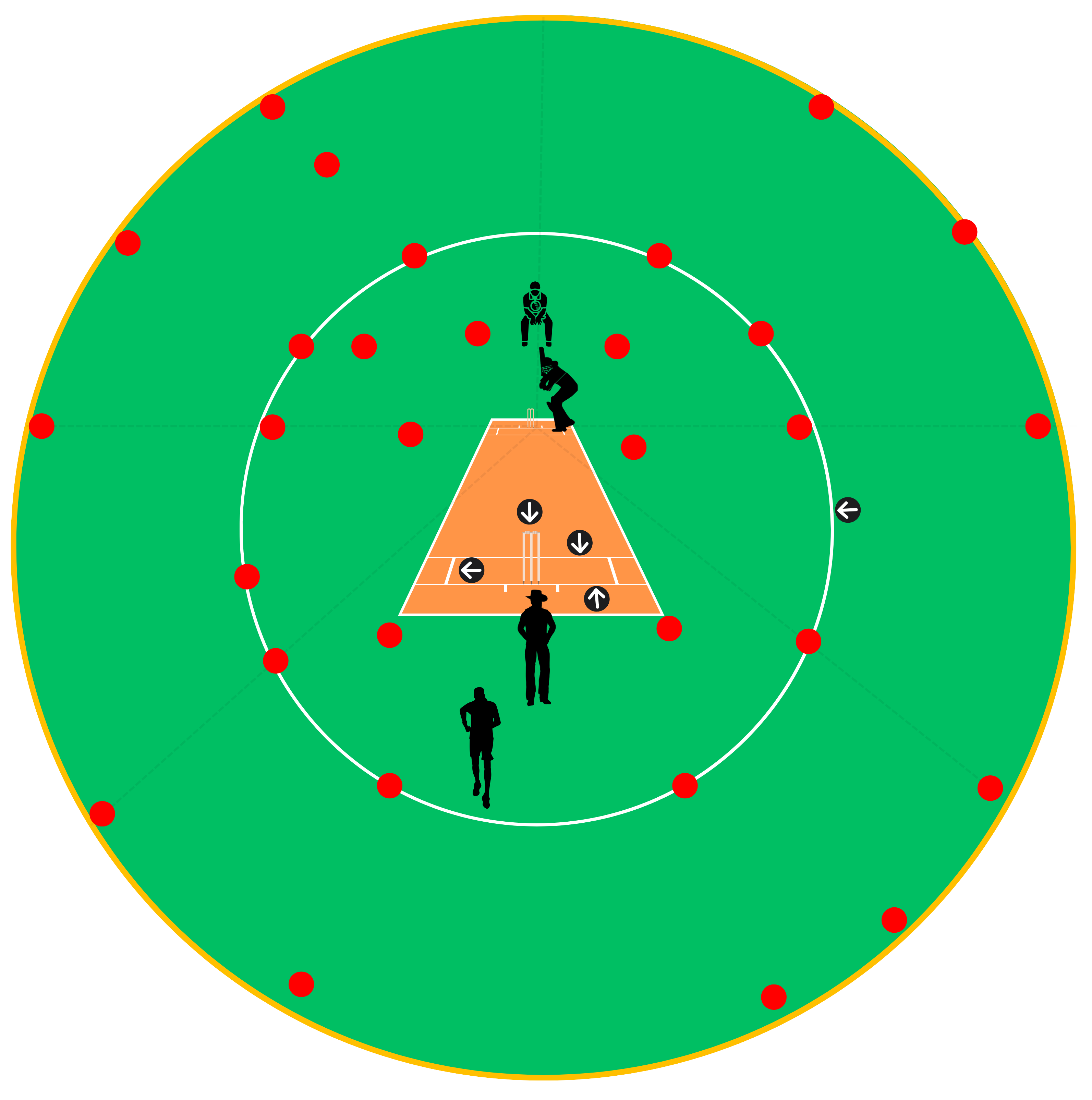
Short Leg
Short leg, also known as bat pad, is a position specifically intended to catch balls that unintentionally strike the bat and leg pad, and thus end up only a metre or two to the leg side.
Silly Mid On
Silly mid on" is a fielding position that's close to the batsman and on the leg side of the field. The fielder's primary goal is to catch a miscued shot or force a run-out
Mid On
Mid-on is a fielding position on the on side of the field, closer to the batsman than long on.The position is named as such because it's roughly halfway between the batter and the boundary on the off side of the field.
Long On
"long on" is a fielding position near the boundary on the off side, directly behind the bowler
Silly Mid Off
Silly mid-off is a fielding position where a player stands close to the batsman on the off side of the field. Fielders with quick reflexes are often assigned to this position.
Mid Off
Mid-off is a fielding position in cricket that is located halfway between the batter and the boundary on the off-side of the field. Note: The off-side is the right-hand side of the field for a right-handed batter.
Long Off
Long off: a fielding position close the boundary on the off side, located in front of, and relatively close to, the line of the wicket.
Cover
The cover position is slightly squarer than mid-off, but more towards the front. A cover fielder situated closer to point than usual is known as cover point.
Point
A cricket fielding position generally given to the most athletic fielder on the team. The point fielder stands square to the batter’s position and will either distance or come close based on the type of bowler in attack.
Silly Point
The silly point cricket fielding position is where the fielder is placed at a 45 degree angle from the opposing batter. This player wears a helmet and is someone brave enough to take on the brunt of a shot from the batter who is facing a spinner.
Gully
Gully is an attacking fielding position behind the wicket on the off side. He stands squarer and deeper than the slips or diagonally in line with the slip fielders. Gully's job is to stop batter's cutting away shots to the boundary off the back foot and take catches that the slips would otherwise miss.
Shirt Third
Position behind the wicket-keeper on the off-side, beyond the slip and gully areas just a little bit finer than a 45-degree angle to the batter.
Mid Wicket
A fielding position intended to save a run on the leg side, located between mid-on and square leg.
Square Leg
A fielding position that is opposite to the point fielder. This player is usually found behind the side umpire, and are usually on their toes to stop any kind of shot a batter hits towards them
Leg Slip
A leg slip fielder is placed on the opposite side of the four slip fielders and close to the wicket-keeper. It must be noted that the fielder is placed when the fielding team has a spinner in attack against the opposing batter.
Fine Leg
A fielding captain assigns a player at the fine leg position, which is less than a 45-degree angle to the hitter behind square on the leg side.
Extra Cover
Extra cover is positioned between the regular cover fielder and mid-off.
Slip
On Occasion generally in test cricket opening spells of bowlers 4 or 5 players are placed diagonally in line with the wicket-keeper, depending whether the bowler decides to bowl either on the off side or leg side of the opposition batter. Each slip fielder stands a bit further away from the other to avoid clashing when a batter edges a delivery between them.
In One Day / T20 as well 1-2 Slip Fielders are placed in Opening bursts
Backward Square Leg
Players at backward square leg are diagonally behind the batter, and tasked with stopping cricket shots such as hook, pull and the sweep.
Backward Point
Backward point is that part of the ground which is just behind the point and finer towards gully and slips on the off side.
Deep Third
Deep Third signifies a fielder positioned further away in the direction of the third slip , Short Third but at the Boundary Line
Third Man
The third man fielder stands in line with the slip fielders just a little bit finer than a 45-degree angle to the batter. They are stationed between deep third and Short third Fielders. This position is mostly used in the limited-over formats.
Deep Backward Point
The fielding captain places a player at deep backward point when a fast bowler is in attack. Like a deep point fielder, this player has to stop square boundary shots by hook or crook. There is a 10 metre distance between the deep point and deep backward point fielders
Deep Point
The role of a deep point fielder is to stop a batter playing boundary shots from square. These players are rarely responsible for taking catches.
Deep Extra Cover
A player assigned at deep extra cover is diagonally in line with the batter on the boundary line. They are placed a little in front of square and are solely responsible for stopping cover drives that go for boundaries.
Cow Corner
This fielder is placed a little bit straighter than the deep mid-wicket, and often is pushed forward to take some high catches. A fielding captain can opt to either switch between cow corner and deep mid-wicket or keep both positions, despite the short distance between the players when fielding.
Deep Mid Wicket
An area of great rewards especially in T20 cricket. The deep mid-wicket player is told to stand on the boundary on the leg side of the field, where batters usually play their most aggressive shots.
Deep Square Leg
A fielding captain places a player at deep square leg with the intention to trick the opposing batter to hit a hook or pull shot. These fielders are stationed deeper in line with the square leg.
Long Leg
Standing at 60 degrees to the opposing batter, a fielder at long leg has to cover the gap between deep fine leg and deep square leg while patrolling the boundary behind square on the leg side.
Deep Fine Leg
Amongst the outfield cricket fielding positions, the deep fine leg is a popular one. Why? Because batters often target this area for runs when bowlers bowl down the leg side and this fielder has to run left and right to safeguard the bound
Wicket Keeper
The most important cricket fielding position. A wicket-keeper stands behind the stumps and affects the opposition batter’s dismissal when the ball edges, misses or leaves them.
Cricket Pitch
The length of a cricket pitch is 22 yards, or 20.12 meters, and it's 10 feet, or 3.05 meters wide, The pitch is a rectangular area on the ground, with bowling creases at each end and imaginary lines on either side. The pitch also needs to have at least 1.22 meters behind the stumps to accommodate the return crease and bowler approach area.
Inner Circle
In cricket, the inner ring is a 30-yard circle within the fielding circle. Fielders in this zone are ready to stop the batsmen from scoring singles. During the first 10 overs of an innings, a maximum of two fielders are allowed outside the 30-yard circle. This is called the 1st powerplay
Popping Crease
The popping crease in cricket is a line that marks the front limit of the batsman's ground. It's a line that's parallel to the bowling crease, and is 4 feet in front of it. The popping crease is considered to be unlimited in length, but it's usually marked to a minimum of 6 feet on either side of the line of the wicket.
Cricket Stump
The three vertical wooden posts that are embedded in the ground at either end of the pitch and support the bails to form the wicket. The stumps are a target for the bowler to hit to dismiss a batsman. The stump on the off side of the wicket is called the off stump, and the stump in the middle is called the middle stump while that on the leg side of the wicket is called Leg stump. The overall width of each wicket is 9 inches (22.9 cm). Each stump is 28 inches (71 cm) tall with maximum and minimum diameters of 1.5 inches (3.81 cm) and 1 3⁄8 inches (3.5 cm).